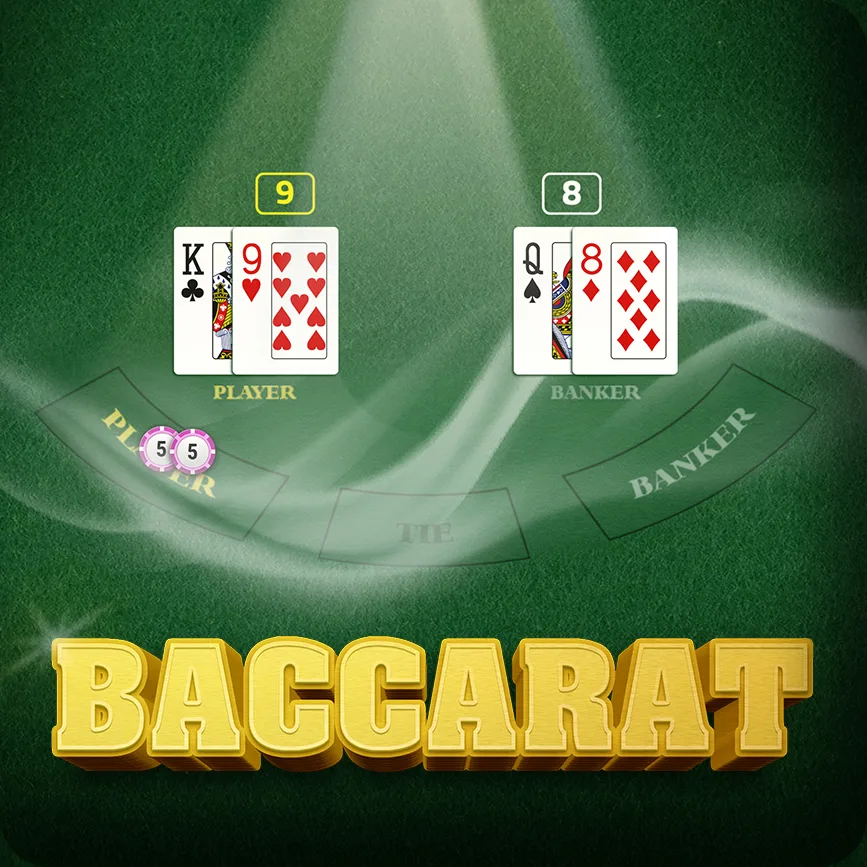
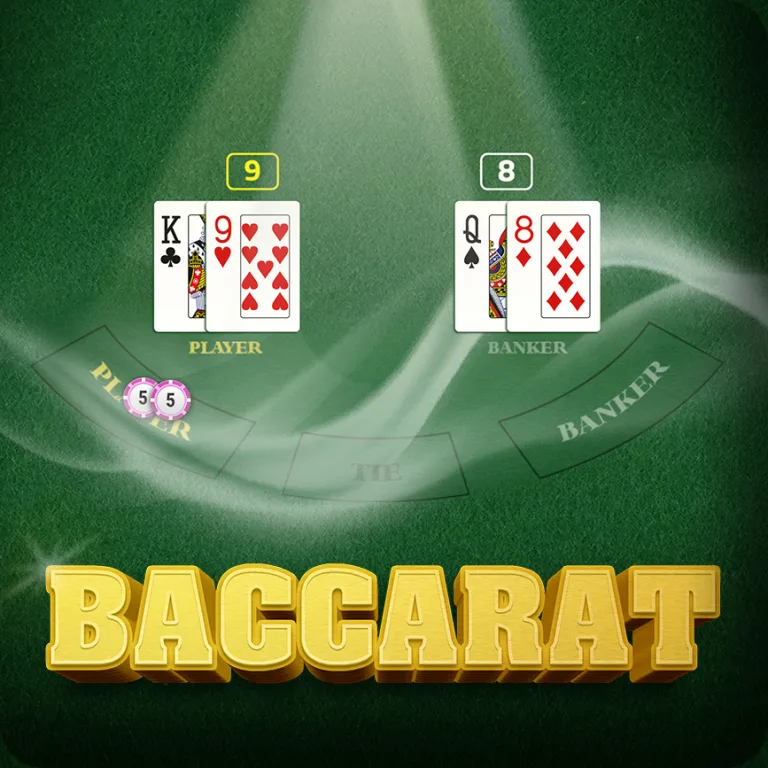
GameArt Baccarat is a fully virtual punto banco table. No dealer is filmed: software draws the cards from an eight-deck shoe and settles each hand within seconds. The game comes from the Maltese studio GameArt, which also supplies a roulette wheel and several blackjack tables to the catalogue.
Bets range from €0.20 up to €1,000, placed on a single box or spread across all three, in demo mode or for real money. What follows covers what the screen asks of you, what each bet pays and how the table's controls change the way you play.
Three boxes sit in the middle of the layout: Player, Banker and Tie. The game's help pages sometimes call the Banker the dealer, but it is the same hand and the same bet.
How much you stake, and how you split it, is entirely up to you. You might add a small chip on the Tie next to a main bet, or back the Player and the Banker at once. That second option protects you from nothing: with two equal chips you break even when the Player wins, and lose 5% of one chip when the Banker wins, because of the commission on that bet.
Once the chips are down, the DEAL button starts the hand. Until then, the stake can still be changed or taken back.
The virtual dealer places two cards in the Player area and two in the Banker area. An ace counts as 1, cards from 2 to 9 count at face value, and tens and court cards count as zero. Whenever the sum goes past 9, the tens digit is dropped.
A hand totalling 8 or 9 on its first two cards is a natural, and the hand ends there for both sides. Otherwise the software follows the third-card chart printed in the help pages. The Player takes a card with 0 to 5 points, then the Banker acts on its own total and on the card the Player has just received. If you would like to follow every draw, the guide on how to play virtual baccarat works through the rules with examples.
The hand finishing closer to 9 wins, an announcer calls the outcome and any winnings go straight to your balance. When both hands end level, your Player and Banker stakes are returned in full.
This table uses the standard punto banco paytable. The return figure given for each bet is worked out for an eight-deck shoe: it shows the share of stakes paid back to players over a very large number of hands, never over a single session.
Player: paid at 1 to 1, for an RTP of 98.76%;
Banker: paid at 0.95 to 1 after a 5% commission, for an RTP of 98.94%;
Tie: paid at 8 to 1, for an RTP of 85.64%.
The 98.95% RTP quoted for this game matches the Banker bet, give or take rounding: the best value of the three despite its commission. A winning €20 chip there returns €19 in winnings. The Tie pays handsomely when it lands, with €5 bringing in €40 on top of the stake returned, yet over time it gives back only a little more than 85%.
Not every table follows this paytable. According to its developer's sheet, the no-commission baccarat from TaDa Gaming pays the Banker bet without any deduction. If you switch between the two, open each game's help screen first: that is where the exact payouts are listed.
Four controls surround the layout:
Repeat lays down the previous hand's stake in one click, with the same split between boxes;
an undo button removes the last chip placed, and another clears all three boxes before the deal;
Turbo switches off the dealing animations without touching the rules or the payouts;
the results board keeps the sequence of previous hands on screen.
Repeat comes in handy for a fixed routine, such as a main bet on the Banker with a small chip on the Tie. With Turbo, it is the pace that changes: more hands per hour, and so a balance that moves faster for the same stake.
Finally, the results board lets you check at a glance how a hand ended if it went by too quickly, particularly in Turbo.
A history display tempts you to look for streaks and bet with them, or against them. The shoe holds no memory you can use, though: a run of Player wins says nothing about the next hand.
Streaks catch the eye because chance produces plenty of them. Over ten hands, the probability of seeing at least one Tie is 63.2%. Twenty hands in a row without a single Tie still happen 13.5% of the time, and the next Tie is no more likely as a result.
The board is therefore a way to check results. When it comes to choosing your next box, it adds no information at all.
The help pages set the minimum stake at €0.20 and the maximum at €1,000. That is the lowest entry point among the baccarat tables at Casino King, which makes it easy to play for a long while on a small balance or to try out a split without risking much.
How your balance swings depends mostly on the box you favour. On Player or Banker, wins and losses alternate almost evenly and the balance drifts gradually. On the Tie, wins are rare but large, and long spells without a payout are part of the game.
Before the first hand, decide how much you are prepared to spend in the session. The responsible gaming tools in your account let you set that limit once, so there is nothing to remember mid-game.
The table also opens in demo mode, using virtual credits. It is the quickest way to find your way around the boxes, try Repeat and Turbo and read the paytable in the help pages without staking real money.
On a phone, tablet or computer, the game runs straight in the browser, with the same layout and the same controls.
For real money, winnings are available the moment the hand ends. From there they can reach your bank account by instant payout, without waiting for any processing period.
GameArt is an independent supplier based in Malta that builds its games for licensed casinos rather than for a site of its own. Like every title in the catalogue, its baccarat is open only to verified players from the age of 21.
Casino King, the Belgium casino holding licence B+19763, is where this table is waiting for you. A hand takes only a few seconds, enough to play several at a small stake before deciding what comes next.