How to play baccarat online: rules, third card and payouts
How do you play baccarat online? Everything comes down to a single decision: before the deal, you bet on the Player's hand, on the Banker's hand or on a tie. After that, nothing depends on you. The cards fall according to fixed rules, third card included, and the hand closest to 9 wins.
This guide walks through those rules in the order they apply at the table: what each bet pays, how a hand is counted, when a third card is drawn, and then three hands explained card by card. Once the drawing rules make sense, the two baccarat casino games at Casino King are easy to follow from the very first deal.
Baccarat rules: three bets, one deal
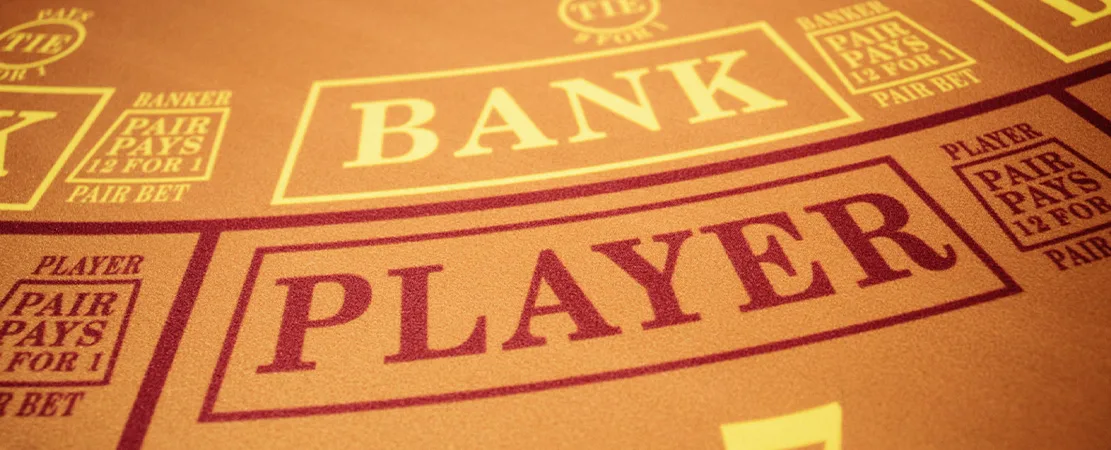
Every deal pits two hands against each other, the Player's and the Banker's. The names come from the original game: online, you are neither one, you simply choose which hand to back. A third box covers a tie between the two.
At a classic punto banco table, a winning Player bet is paid at even money, 1 to 1. So is a Banker bet, less a 5 per cent commission taken from the win: a €10 stake therefore wins €9.50. A tie pays 8 to 1. When both hands finish on the same total, Player and Banker bets are neither won nor lost: they are returned to you.
Some tables drop the commission on the Banker and usually adjust another payout to balance it. According to its developer's sheet, that is the case with TaDa Gaming's Baccarat. Before playing, open the game's help screen: it lists the exact payouts used at that table.
What is a baccarat hand worth?
The count works the same way for both hands. Cards from 2 to 9 are worth their number, the ace is worth 1, and the 10, jack, queen and king are worth 0. You add the cards together and keep only the last digit.
A 9 and an 8 make 17, so the hand is worth 7. A king and a 10 make 0, the lowest possible total, and that is exactly what the word baccara means at the table: a hand worth nothing. A hand can never go above 9, so unlike blackjack nobody goes bust.
If either hand reaches 8 or 9 with its first two cards, it is called a natural. The deal stops at once for both hands, with no third card, and the higher total wins.
The Player's third card
Without a natural, the Player's hand is settled first, under one simple rule:
on a total of 0 to 5, the Player receives a third card;
on a total of 6 or 7, the Player stands on two cards.
There is nothing for you to ask for or turn down: the dealer, or the software at a virtual table, applies this rule on your behalf. That is the big difference from a hand of blackjack, where every extra card is the player's own decision.
When does the Banker draw a third card in baccarat?
The Banker's rule depends on what has just happened on the Player's side. If the Player stood on two cards, the Banker follows the same rule: draw on 0 to 5, stand on 6 or 7.
If the Player did take a third card, the Banker looks at both its own total and the value of that card:
on 0, 1 or 2, the Banker always draws;
on 3, it draws unless the Player's third card is an 8;
on 4, it draws if that card is worth 2 to 7;
on 5, it draws if the card is worth 4 to 7;
on 6, it draws if the card is a 6 or a 7;
on 7, it stands.
You do not need to learn this chart to play, since the drawing happens on its own. Knowing it lets you follow a deal and see where the Banker's slight edge comes from: it acts last, with information the Player's hand never had.
An exact calculation for an eight-deck shoe gives a sense of scale: roughly one deal in three (34.3%) ends on a natural, the Player draws a third card in half of all deals (50.3%) and the Banker in 43.5% of them.
Three baccarat hands played out step by step
First hand. The Player is dealt a 2 and a 3, making 5, so it draws and receives a 6. Its total becomes 11, which counts as 1. The Banker holds a king and a 4, making 4. The Player's third card, a 6, falls between 2 and 7, so the Banker draws too, receives a 5 and finishes on 9. The Banker wins, and a €10 Banker bet returns a €9.50 win.
Second hand. The Player holds a 7 and a queen, making 7, and stands. The Banker holds a 3 and a 2, making 5. Since the Player did not draw, the Banker applies the simple rule and draws on 5. It receives a 2 and also reaches 7. It is a tie: the tie bet is paid 8 to 1, and Player and Banker bets are handed back.
Third hand, for the best-known exception. The Player starts with an ace and a 3, draws an 8 and ends on 2. The Banker, on 3 with two cards, does not draw, because the Player's third card is an 8. The Banker wins 3 to 2 without receiving another card.
In each of these cases, a win is credited as soon as the deal ends, and withdrawals paid out within seconds can then send it straight to your bank account.
Which baccarat bet should you choose?
The three bets do not cost the same over time. With a shoe of eight decks, the house edge sits at about 1.06% on the Banker, commission included, and 1.24% on the Player. A tie paid at 8 to 1 climbs to 14.4%: the odds look generous, but they do not make up for how rarely a tie lands.
The Banker is therefore the cheapest bet, without guaranteeing anything: five deals in a row without a Banker win happen about 4.7% of the time, or roughly one run of five in 21. The results board some tables display tells the story of past rounds, not the next one.
Betting systems do not change those percentages. The Martingale strategy, which doubles the stake after every loss, soon runs into two limits. The first is the table maximum: starting from €0.20 at a table capped at €1,000, the thirteenth bet reaches €819.20 and a fourteenth is no longer allowed. The second is the commission: on the Banker it trims every win, so after five losses in a row the next win no longer even covers the stakes already lost.
Shoe, natural, punto banco: the language of the table
A handful of terms come up again and again around a baccarat table, and they make a game's help screen easier to read:
Punto banco: the form played in most casinos, including both tables at Casino King. The drawing follows the rules above, with no choice to make.
Chemin de fer: the salon version in which players take turns holding the bank. Whoever plays a hand there may choose whether or not to draw on a 5.
Mini-baccarat: a smaller table with lower stakes, where the dealer handles all the cards. The rules remain those of punto banco.
Shoe: the box holding the shuffled cards, eight 52-card decks in
Natural: a total of 8 or 9 with the first two cards.
Deal: one complete round, from the bet to the result.
Commission: the share kept from winnings on a Banker bet.
Practise online baccarat before you bet
The easiest way to take these rules in is to watch them in action. Both Casino King tables open in demo mode with a play-money balance: a few deals are enough to spot the betting boxes, follow the third card and find the payouts in the game's help screen.
When playing for real money, set your budget before the first deal. A baccarat hand takes only a few seconds and the total you stake adds up quickly; a deposit cap set in your account keeps that pace under control.
Casino King, the instant online casino holding Belgian licence B+19763, keeps its tables for players aged 21 and over. They apply exactly the rules in this guide: all that is left is to choose your bet.
Blog

Ante bet explained: pay more per spin to see more scatters
The ante bet costs 25 to 50% more per spin to land more scatters. What it really buys, what it leaves unchanged and when it is worth switching on.

Withdraw your winnings at Casino King: the 5 steps to follow
The 5 steps to withdraw your winnings at Casino King, the one-off bank account check, and the 3 reasons a withdrawal can be held up in the meantime.

Casino with Mastercard or Visa: deposit with your debit card
Visa Debit and Debit Mastercard accepted at Casino King: deposits from €10, credited instantly, approved in your banking app and free of casino fees.

Martingale roulette: how far can you double your stake?
Martingale, Grand Martingale, d'Alembert, Fibonacci and Paroli: what each system has you stake at roulette, from €0.10 all the way up to the table limit.

Casino mistakes to avoid: tips for safer play
Discover the most common casino mistakes to avoid to better manage your budget, play responsibly, and enjoy the game without unpleasant surprises.

Why have online casinos Belgium become so popular?
With its reassuring legal framework, its wide variety of games and its full mobile accessibility, discover why online casinos Belgium are experiencing such remarkable success.