Ante bet explained: pay more per spin to see more scatters
On some slots, a single setting lets you pay a little more for every spin. That is the ante bet. In return, the symbols that open the bonus feature land more often. You do not win more over time: what changes is the pace of the game, and the price of each spin.
The figures in this article are not a market average. They come from the help screens of two Pragmatic Play games you can play at Casino King, Gates of Olympus Dice and its Super Scatter version. What the extra costs, what it actually buys, why it leaves the return to player where it is, and when it is worth switching on: all of it is covered here, with the sums shown.
One point before going further. The ante affects your chances to trigger the free spins, or whichever feature plays that role. The rules of the feature itself stay the same, whether you pay the extra or not.
What exactly do you pay for with an ante bet?
The word comes from poker, where the ante is the small amount every player puts in before the deal. On a slot, the idea is similar: an amount added before the spin, not to win anything directly, but to change what the spin can produce.
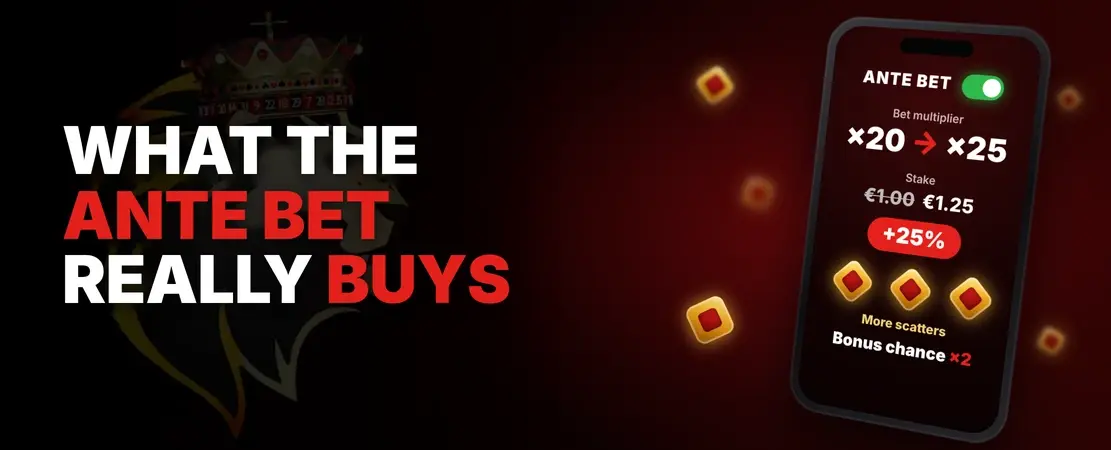
At Pragmatic Play, everything runs through a setting most players never look at: the bet multiplier. Without the extra, the game counts 20 units per spin; with it, the count rises to 25 or 30, while the value of each unit stays the same. A displayed stake of €1 therefore becomes €1.25 or €1.50, depending on the game.
The key detail fits in one line of the Gates of Olympus Dice help screen: all wins are multiplied by the base bet. Your base bet stays at €1, even when you pay €1.25. A win of 10 times the stake pays €10, not €12.50. The extra 25 cents fund no win at all: they only put more scatters on the reels. That is why it helps to know what scatters do: in these games, they are what opens the bonus feature, and they are all the extra pays for.
Pragmatic Play's ante feature raises the multiplier to 25 or 30
On Pragmatic Play's Gates of Olympus Dice, the option lifts the multiplier from 20 to 25, so each spin costs 25% more. The help screen puts it plainly: the chance of winning the free spins naturally is doubled, and more scatter symbols are present on the reels.
The round itself does not change. Four or more scatters open it with 15 free spins, three scatters add 5 more along the way, and every multiplier that comes with a win is added to a running total kept until the end. The ante makes the way in more frequent, without touching anything that happens once you are through the door.
The Super Scatter edition goes further. Its setting takes the multiplier to 30 instead of 20, so a spin costs half as much again. In return, scatters and super scatters appear more often, although the studio does not put a figure on the difference as it does for the original. On both titles, stakes start at €0.20 before the extra.
A side-by-side study of the help screens for five games in the catalogue shows that the option is far from universal. Lucky Dice and Fruit Party Dice do not mention it. On the two Pragmatic Play titles that offer it, the extra ranges from 25% to 50% per spin, the return figure shifts by between zero and five hundredths of a point, and the direct purchase disappears in both cases. The fifth, 777 Win Spinner, applies the same idea in another form, covered further down.
Where the option exists, it has its own section on the ante in the help screen, listing what it does and what it switches off. That is the first screen to open before touching it.
Why the RTP barely moves
On Gates of Olympus Dice, the help screen shows three theoretical return figures: 96.50% in normal play, 96.50% with the ante and 96.50% with the direct purchase. On the Super Scatter version, the extra takes the figure from 96.50% to 96.55%, a difference of five hundredths of a point.
An identical figure has a simple consequence: on average, the extra scatters give back what the extra costs, no more and no less. You pay more and receive more in proportion. In the very long run, the share kept by the game stays the same, give or take a few hundredths in the case of Super Scatter Dice.
Two common beliefs fall away at this point. The ante does not "make you win more": it shifts part of the winnings towards the bonus feature without raising the average. Nor does it catch up on anything. Each spin is drawn independently of the last, so switching the option on after a long run without a bonus makes the next one no more likely than if you had used it from the start. The Gates of Olympus Dice help screen also shows a single volatility rating, medium, with no distinction between settings.
The real price of a bonus with the ante option
Because Gates of Olympus Dice gives two precise figures, you can do the sum. A spin costs 1.25 times as much and the chance of opening the round is doubled. The amount staked on average before the feature opens is therefore multiplied by 1.25 divided by 2, which is 0.625: a fall of 37.5%. Put another way, on the same budget you will see 1.6 times as many bonus rounds on average.
The trade-off lies in the help screen line quoted above. Every win is still worked out on the base bet, which is now only 80% of what you pay. More bonuses on one side, wins counted on a smaller base than your spend on the other: the two effects cancel out, which is why the return figure does not change.
On this game, the ante option comes down to five points:
each spin costs 25% more;
the chance of triggering the free spins naturally is doubled;
the round's rules and the 96.50% return stay the same;
wins are still worked out on the base bet;
buying the free spins is no longer available.
For the Super Scatter version, the same sum cannot be done: the studio says scatters land more often, without saying by how much. Rather than make a figure up, keep the principle in mind: 50% more per spin, in exchange for a more frequent bonus whose exact gain is not published.
What do 200 spins cost with the ante stake switched on?
The return figure holds steady, but the amount you put in goes up. Take 200 spins at a base bet of €1. Without the extra, you stake €200. With the Gates of Olympus Dice setting, that becomes €250, and with the Super Scatter one, €300.
Now apply the published return figures. Over a large number of sessions like these, the game would keep €7.00 on average in the first case, €8.75 in the second and €10.35 in the third. The percentage barely changes, if at all, but it applies to more money: the average loss in euros rises with the extra. In any single session, actual results stray much further from these averages, in either direction.
The other effect concerns how long you play. On a €200 budget, leaving aside any winnings played back, you get 200 spins without the extra, 160 with the first setting and about 133 with the second. If the option cuts your sessions too short, setting a deposit limit before touching it is the easiest way to stay in control.
The ante bet on slots rules out buying the free spins
On both games, you have to choose. At the base stake, a button lets you buy the round outright: 100 times the base bet on Gates of Olympus Dice, 100 or 500 times on the Super Scatter version, where the dearer option starts super free spins with a multiplier already set at 10× or more. As soon as the ante is switched on, that button disappears, and it only returns with the base setting.
Both options serve the same wish, getting to the bonus feature, but follow opposite logics. The ante spreads the extra cost over every spin and leaves chance to pick the moment. The purchase puts the whole outlay into one payment, known in advance, and opens the feature straight away. At a €1 base bet, that payment is €100, the same as the ante extra on 400 spins of Gates of Olympus Dice.
Neither is "the right one" in absolute terms: on Gates of Olympus Dice, both show the same return figure. The difference lies in how you spend, gradually or all at once. Not all slots with a bonus buy at Casino King offer an ante, either: for each title, the help screen tells you whether the two options can coexist or cancel each other out.
Air Dice sells the bonus chance spin by spin
Air Dice uses a similar idea with a more direct display. On Air Dice's 777 Win Spinner, the purchase screen offers two chance boosts: the first makes the Spinner Bonus three times as likely, the second ten times as likely. The price is shown in euros for each spin, and the boost stays on until you press the button to deactivate it.
On the screen we looked at, the first boost takes the price of a spin to twice the stake, the second to five times. The difference from Pragmatic Play is legibility: the gain in probability is printed in large type, right beside the price. Bear in mind that the extra is charged on every spin for as long as the boost is on, just like an ante left running.
Volt Xtreme, another Air Dice title available at Casino King, also offers an option of this kind. Its terms are set out in the game's help screen, as with Pragmatic Play: that remains the only reliable reference before you switch anything on.
When is it worth switching the ante on?
The option suits short sessions best, when the aim is to see the bonus feature more often and the budget has been set with that in mind. For long sessions at small stakes, the base setting makes the same budget last longer, at the same return figure.
The safest route is to try it first. At Casino King, the ante also works in demo mode: a few dozen spins with the setting and then without it are enough to feel the difference in pace and spend, without risking a single euro. You then move on to real money knowing exactly what you are paying for. Reading the help screens side by side also brings out three traps: looking in vain for the purchase button while the ante is on, assuming a win will be worked out on the amount you actually paid, and leaving an Air Dice boost running, since it stays on until you switch it off. Dice slots such as Gates of Olympus Dice and its Super Scatter version also count towards the daily Boosts on the site, just like dice games.
One setting, one price, one measurable effect: once the numbers are on the table, the ante bet holds no mystery. To try it on Pragmatic Play and Air Dice games, Casino King, the reference among online casinos in Belgium, licensed B+ by the Belgian Gaming Commission, opens every title in demo mode and for real money, with instant withdrawals when you cash out. Play is limited to adults aged 21 or older.
Blog

Withdraw your winnings at Casino King: the 5 steps to follow
The 5 steps to withdraw your winnings at Casino King, the one-off bank account check, and the 3 reasons a withdrawal can be held up in the meantime.
Casino with Mastercard or Visa: deposit with your debit card
Visa Debit and Debit Mastercard accepted at Casino King: deposits from €10, credited instantly, approved in your banking app and free of casino fees.

Martingale roulette: how far can you double your stake?
Martingale, Grand Martingale, d'Alembert, Fibonacci and Paroli: what each system has you stake at roulette, from €0.10 all the way up to the table limit.

Casino mistakes to avoid: tips for safer play
Discover the most common casino mistakes to avoid to better manage your budget, play responsibly, and enjoy the game without unpleasant surprises.

Why have online casinos Belgium become so popular?
With its reassuring legal framework, its wide variety of games and its full mobile accessibility, discover why online casinos Belgium are experiencing such remarkable success.

Sic Bo: master the art of dice games in the casino
Discover our complete Sic Bo guide: rules, strategies and expert tips to play this iconic dice game found in online casinos. Master Sic Bo and maximise your winnings with Casino King.